This is a headline
The Invisible Gatekeeper: How AI Recruitment Agents Are Reshaping Hiring Platform Visibility
Roth Miklos
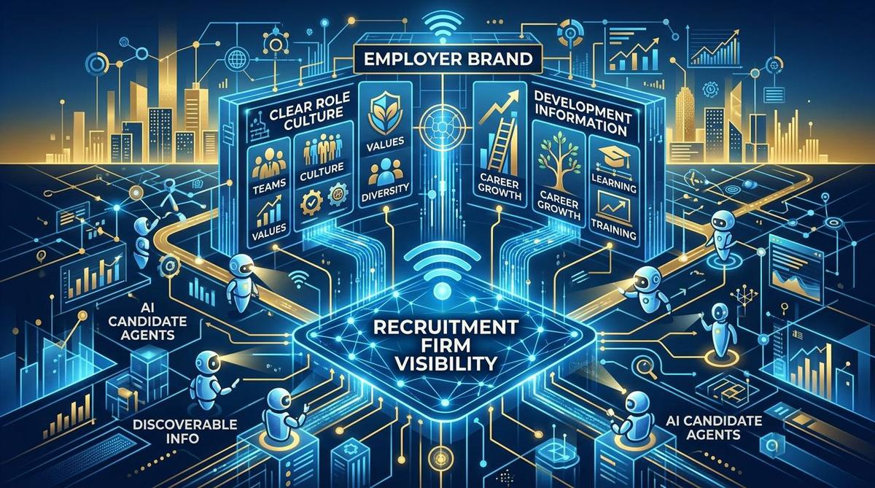
A seismic shift is underway in how candidates discover job opportunities. Increasingly, job seekers delegate search and application tasks to AI agents, intelligent systems that scan job boards, parse requirements against candidate profiles, and even submit applications autonomously. For recruitment firms and employers, this transformation demands fundamental reconsideration of how they achieve visibility in an ecosystem where human eyeballs no longer drive discovery.
Traditional recruitment marketing optimized for human job seekers: compelling job descriptions, prominent platform placement, employer branding content designed to attract attention. AI agents operate on entirely different principles. They parse structured data fields, match keywords against candidate profile ontologies, evaluate compatibility through algorithmic scoring, and prioritize opportunities based on criteria that may differ substantially from human decision heuristics.
The implications for recruitment firm visibility are profound. Job postings with inconsistent formatting, ambiguous requirement descriptions, or missing structured data fields may be invisible to sophisticated AI agents even when perfectly matched to candidate qualifications. Rich text descriptions that appeal to human readers may confound parsing algorithms. Location descriptions like “greater metropolitan area” rather than specific postal codes fail geographic matching filters.
Technical optimization for AI agent discoverability mirrors SEO in important respects. Structured data markup using standardized schemas enables precise agent comprehension. Consistent, unambiguous terminology in requirement descriptions prevents matching failures. Complete metadata, salary ranges, remote work policies, benefits details, provides the data points agents use for candidate filtering.
However, the parallel has limits. Unlike search engine crawlers that follow relatively predictable patterns, recruitment AI agents operate across a fragmented ecosystem of platforms, each with proprietary matching algorithms. A posting optimized for one agent may underperform with another. This fragmentation demands broad-spectrum optimization rather than platform-specific strategies.
The quality imperative intensifies. AI agents increasingly incorporate reputation signals and review data into their matching logic. Recruitment firms with poor candidate reviews, slow response times, or misleading job descriptions see their opportunities deprioritized by sophisticated agents acting as candidate advocates. Visibility optimization without underlying service quality becomes unsustainable.
Content strategy must evolve as well. AI agents seeking to understand employer value propositions scan beyond individual postings to corporate career pages, social media presence, and third-party review sites. Consistent, authentic employer brand expression across these touchpoints improves agent comprehension and candidate matching accuracy.
Personalization at scale becomes achievable through AI agent interactions. When agents understand both candidate preferences and employer offerings with precision, matching quality improves dramatically for both parties. Recruitment firms that invest in rich, structured employer data position themselves to benefit from this matching sophistication.
The technical performance of recruitment platforms increasingly affects discoverability. Slow-loading career pages, mobile-unfriendly applications, and complex authentication requirements create friction that AI agents may interpret as negative signals. Technical optimization of recruitment infrastructure, a domain explored comprehensively at https://www.szonyegtisztitas.org/core-web-vitals-2026-rankings-revenue.php, directly impacts how AI agents evaluate and prioritize opportunities. Core Web Vitals and technical performance metrics that influence search rankings similarly affect agent-driven discovery, making technical excellence a prerequisite for recruitment visibility.
Key Takeaways: - AI recruitment agents are replacing human browsing as the primary job discovery mechanism for many candidates - Structured data, consistent formatting, and complete metadata enable AI agent parsing and matching - Reputation signals and review data increasingly influence agent opportunity prioritization - Technical platform performance, including Core Web Vitals, affects agent-driven discovery rankings
Resources: https://www.szonyegtisztitas.org/core-web-vitals-2026-rankings-revenue.php
This is a heading
This is a paragraph. You can use this to communicate content within your page.
© Copyright Önfejlesztés